
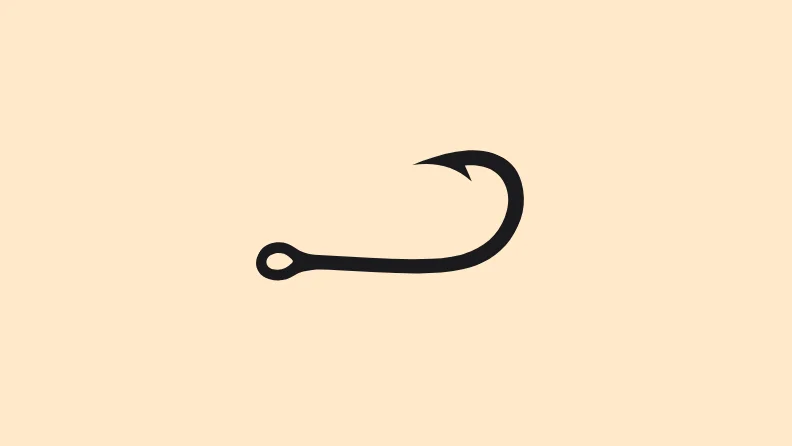
Strip away the politics and fish hook theory is really a warning about a specific kind of blind spot. A position that looks moderate on paper can still end up landing very close to one extreme in practice.
That warning translates directly to product work. Here’s how.
The core idea, minus the politics
Picture a decision spectrum instead of a political one. One end is “ship whatever, fast.” The other end is “polish forever, never ship.”
A compromise position looks like it sits safely in the middle. But the actual outcome can curve back toward one end anyway, the same way a hook curves back toward its own shank.
Why this happens at work:
- The loudest stakeholder usually anchors the “middle,” not the true center
- Deadlines quietly punish the polish end and reward the ship-fast end
- Sunk cost quietly punishes the ship-fast end and rewards the polish end
- Nobody notices the drift because everyone still calls it “the compromise”
Where this shows up in product management
1. Roadmap prioritization
A roadmap built from “balanced” stakeholder input often isn’t balanced at all.
- Sales wants revenue features
- Support wants bug fixes
- Engineering wants tech debt paid down
- Leadership wants the flashy thing for the next board deck
The resulting roadmap usually looks like a compromise. In reality it often curves hard toward whichever group has the most organizational leverage, most commonly sales or leadership. The other groups get token line items that read as fairness but function as decoration.
What to do:
- Name the leverage imbalance out loud in planning meetings
- Track roadmap outcomes over two or three quarters, not one, to see the real curve
- Protect a fixed percentage of capacity for the quieter voices (support, tech debt) regardless of who’s loudest that quarter
2. Scope negotiation
“Let’s cut it down to an MVP” sounds like the moderate, sensible choice. It can still hook back toward one extreme.
- Cut too aggressively and you’ve shipped the “fast” extreme wearing an MVP costume
- Keep adding “just one more thing to make it viable” and you’ve shipped the “polish forever” extreme wearing an MVP costume
What to do:
- Write down what “viable” means before scoping starts, not during the debate
- Re-check the actual feature list against that definition at the end, not just the vibe in the room
- Ask directly: does this final list look more like Extreme A or Extreme B dressed up as a compromise
3. Stakeholder alignment meetings
A meeting that “hears everyone out” and ends in a neutral-sounding summary can still be captured by one perspective.
Common pattern:
- The most senior person in the room states an opinion early
- Everyone else’s “input” quietly adjusts toward that opinion
- The final decision gets labeled “team consensus”
- It was actually one person’s original position, barely modified
What to do:
- Collect opinions in writing before the meeting, not live in the room
- Have the most senior person speak last, not first
- Watch for a “consensus” that happens to match exactly what the highest-status person said at the start
4. Customer feedback synthesis
Averaging feedback feels neutral. It isn’t automatically.
- A handful of vocal power users can pull the “average” request toward their specific workflow
- A handful of loud complaints can pull the roadmap toward fixing problems that affect very few people
- The synthesis document still gets written up as “what customers want”
What to do:
- Weight feedback by segment size, not by volume or persistence
- Separate “loud” from “large” explicitly in the synthesis
- Flag when a request cluster is coming from three accounts versus three hundred
5. Conflict resolution between engineering and design
A PM playing referee between engineering (“this will take too long”) and design (“this is what the user needs”) often thinks they’re landing in the middle.
Watch for these tells that you’ve actually drifted:
- You keep siding with whichever team pushed back hardest last, not whichever argument was strongest
- Your “compromise” always seems to save the same team’s timeline
- The team that loses more often stops raising objections, not because they agree, but because they’ve learned it doesn’t change anything
What to do:
- Keep a simple log of which side’s position won each dispute over a quarter
- If one side wins nearly every time, that’s the hook curving, not a coincidence
- Bring in a third opinion (data, a user test, a neutral senior IC) when the pattern looks lopsided
The general lesson
The failure mode isn’t taking an extreme position. People notice and challenge extreme positions.
The failure mode is a position that gets labeled “the middle ground” while actually sliding toward whichever side has more power, more volume, or more time pressure behind it. The label does the damage, because it turns off everyone’s instinct to double-check the outcome.
A short checklist to catch it:
- Would this decision survive being described accurately, without the word “balanced” or “compromise” attached to it?
- If you swapped which side spoke first, or which side was loudest, would the outcome change?
- Looking back over the last few decisions like this one, is there a pattern of always landing on the same side?
If the honest answer to any of these is uncomfortable, the “middle ground” probably wasn’t one.
